


 PLATFORM UPDATE:


Intrinsic electrocatalytic activity of nitrogen-doped monolayer graphene observed using a Janus bilayer design
 a
Cathy
Sulaiman,
b
Raquel
Sánchez-Barquilla,
b
Isabell
Wachta,
a
Jan Ingo
Flege
b
and
Kannan
Balasubramanian
*a
a
Cathy
Sulaiman,
b
Raquel
Sánchez-Barquilla,
b
Isabell
Wachta,
a
Jan Ingo
Flege
b
and
Kannan
Balasubramanian
*a
Abstract
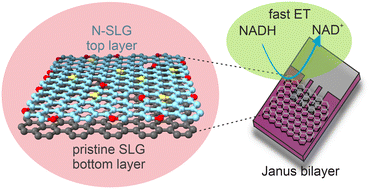
Nitrogen doping is a widely-used strategy for enhancing the electronic and electrocatalytic properties of graphene. On single-sheet graphene electrodes, substrate-induced charge density effects obscure their intrinsic behavior and limit the efficiency of surface-sensitive electron transfer. Here, we report a Janus bilayer electrode architecture that decouples a nitrogen-doped graphene top layer from the substrate via a pristine graphene bottom layer. This design allows the presentation of catalytically active nitrogen sites while simultaneously suppressing substrate effects, enabling a direct evaluation of the intrinsic effect of nitrogen-doping on the electron transfer (ET) properties of graphene. Using ferricyanide as a redox-probe, we show that the ET kinetics of pristine bilayer graphene are pH-dependent, while nitrogen-doped bilayer graphene displays stable, pH-independent redox behavior. As an application avenue of biological relevance, we demonstrate that nitrogen-doped bilayer graphene exhibits a reduced overpotential for NADH oxidation. These results demonstrate that the synergy between substrate decoupling and controlled nitrogen incorporation yields a robust electrode architecture with enhanced stability and improved electrocatalytic activity.
 Please wait while we load your content...


