


 PLATFORM UPDATE:


Persistent, broad-spectrum antimicrobial activity of multi-metal surface phase-modified ceria nanozymes
 a
Khao Minh
Ta,
e
Joanna
Wojewoda-Budka,
d
Natalia
Sobczak,
d
Marco
Molinari,
e
Sudipta
Seal
*abc
a
Khao Minh
Ta,
e
Joanna
Wojewoda-Budka,
d
Natalia
Sobczak,
d
Marco
Molinari,
e
Sudipta
Seal
*abc
Abstract
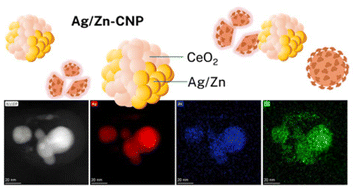
With the growing threat of emergent microbes, such as novel viruses and drug-resistant bacteria, more robust and broad-spectrum antimicrobial technologies are of critical importance. Nanomaterials have the potential to deliver broad-spectrum antimicrobial effects while maintaining resistance to degradation in various application environments. In the present study, a multi-metal oxide nanoparticle formulation with substantial antimicrobial activity was developed, outperforming a previous bimetallic composition. The formulation was produced through a variation of an established method wherein the multi-metal oxide is formed through precursor ageing in a peroxide solution environment (room temperature, 8-week ageing period). Silver/zinc-modified cerium oxide nanoparticles exhibited substantial antiviral (0.05 mg mL−1 reduced virus titer to beyond detectable ranges for RV14 rhinovirus; ∼3 log reduction for vesicular stomatitis virus upon treatment with 0.15 mg mL−1 in TCID50) and antibacterial (MIC values of ∼4, 6, and 6 μg mL−1, respectively, for P. aeruginosa, S. aureus, and methicillin-resistant S. aureus (MRSA)) activities. Of further interest, this nano-formulation evidenced persistent antibacterial activity towards bacterial (P. aeruginosa and S. aureus) and viral (RV14 rhinovirus; vesicular stomatitis virus, VSV) lab strains resistant to previously developed silver-modified cerium oxide nanoparticles. Nanomaterial characteristics and potential antimicrobial mechanisms were also investigated, with enzyme-mimetic nanozyme generation of reactive oxygen species suggested by density functional theory calculations.
 Please wait while we load your content...


