


 PLATFORM UPDATE:


Laser writing of plasmonic catalytic microchannels on UiO-66 layer
 ab
Swagato
Sarkar,
cd
Dmitry
Kogolev,
a
Wanderson
Ferraz do Valle,
b
Thomas
Schachinger,
e
Alexey
Ivanov,
a
Markus
Valtiner,
b
Pavel S.
Postnikov
*ag
and
Olga
Guselnikova
*b
ab
Swagato
Sarkar,
cd
Dmitry
Kogolev,
a
Wanderson
Ferraz do Valle,
b
Thomas
Schachinger,
e
Alexey
Ivanov,
a
Markus
Valtiner,
b
Pavel S.
Postnikov
*ag
and
Olga
Guselnikova
*b
Abstract
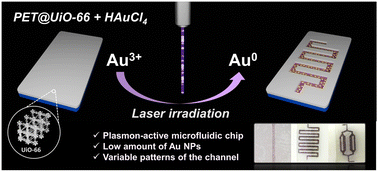
Plasmon-assisted catalysis offers an attractive route for solar-to-chemical energy conversion, yet its practical integration into scalable flow systems remains limited by complex fabrication steps and poor nanoparticle stability. Here, we report a one-step laser-assisted method for simultaneously forming gold nanoparticles (Au NPs) and patterning microchannels on metal-organic framework (MOF)-functionalized polyethylene terephthalate (PET) substrates derived from waste plastic. Using a 405 nm laser, the in situ reduction of HAuCl4 within a UiO-66 matrix deposited on PET enables homogeneous Au NPs formation (≈5.4 nm) and precise microchannel definition without the need for additional reagents or post-processing. The resulting PET@Au composites exhibit strong plasmon resonance at 550 nm and catalytic activity for the degradation of methylene blue under visible light, confirming their functional performance. This approach combines plasmonic functionality, low-cost materials, and sustainable processing into a scalable platform for the development of integrated microfluidic and photocatalytic devices.
- This article is part of the themed collection: Frontiers in plasmonic science and applications
 Please wait while we load your content...


