


 PLATFORM UPDATE:

Advancing 1.84 eV wide-bandgap perovskite solar cells via multidentate molecular engineering

Abstract
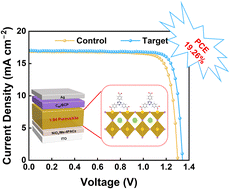
Wide-bandgap perovskite solar cells (PSCs) suffer from halide phase segregation, where the bromine-rich domain tends to precipitate during crystallization. This results in an uneven halide distribution and the generation of defects, acting as non-radiative recombination centers that limit both device efficiency and operational stability. Herein, we introduced the multidentate additive 2,4,6-tris(4-carboxyphenyl)-1,3,5-triazine (H3TATB)—a planar, π-conjugated molecule with high C3 symmetry and three terminal carboxyl (–COOH) groups anchored to a triazine core. The incorporation of H3TATB into the perovskite precursor slows perovskite crystallization kinetics and it preferentially coordinates with Br-rich species, effectively regulating halide distribution. The resulting H3TATB-modified films exhibit a homogeneous composition, enhanced crystallinity, and significantly reduced defect density. Moreover, these films show an average contact potential difference value of 0.23 V, notably lower than the 0.32 V of the control film, indicating a reduced work function and n-type doping characteristics that facilitate efficient electron extraction at the interface in p–i–n devices. Wide-bandgap PSCs (1.84 eV) incorporating H3TATB achieve a power conversion efficiency of 19.26%, retaining 88.06% of the initial efficiency after 800 h under ambient air conditions (30% RH). This work demonstrates that targeted molecular additives can effectively suppress Br-rich phase precipitation, mitigate halide segregation, and promote uniform perovskite film growth—providing a viable pathway toward high-performance, stable wide-bandgap perovskites for tandem solar cell applications.
 Please wait while we load your content...


