


 PLATFORM UPDATE:


Magneto-catalytic bio-hybrid bacterial bots efficiently eradicate and remove biofilms in catheters
 ab
and
Arun
Chattopadhyay
*ac
ab
and
Arun
Chattopadhyay
*ac
Abstract
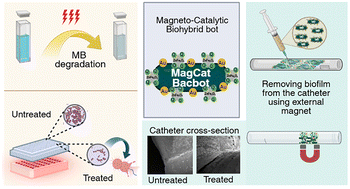
Biohybrid microbots, which combine biotic moieties with nanoscale functional components, offer to accomplish multifunctional tasks in theranostics while also being guided by external forces. Herein, we report that magneto-catalytic bacterial bots (MagCat bacbots), fabricated with quercetin-functionalized zinc ferrite nanoparticles mounted onto gold nanocluster-bearing Lactobacillus bacteria, perform magnetically guided biofilm eradication through Fenton-like catalysis. MagCat bacbots catalyze efficient degradation of methylene blue (86%) and rhodamine B (80%) dyes via Fenton-like ˙OH radical generation, without requiring exogenous H2O2 and with improved rates under red-light irradiation. Antibacterial evaluation shows a substantial reduction in biofilm viability, down to 10% and 14% for S. aureus and P. aeruginosa, respectively. Additionally, reactive oxygen species generation in the treated biofilms increases with concurrent glutathione depletion, and lipid peroxidation contributes to membrane disruption and eventually bacterial cell death. Furthermore, MagCat bacbots demonstrate precise and magnetically guided biofilm removal from planar surfaces and confined geometries such as catheter walls. This work highlights a multifunctional biohybrid system as a smart strategy for catalysis and biofilm eradication.
- This article is part of the themed collection: Prof. Amitava Patra's 60th birthday: Current advancements in photonic materials and spectroscopy
 Please wait while we load your content...


