


 PLATFORM UPDATE:


Surface-percolated GNP coatings on 3D-printed PLA lattices for tunable EMI shielding and flame-retardant multifunctionality

Abstract
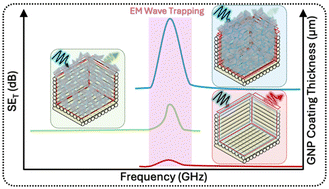
The growing demand for lightweight systems capable of integrating multiple functionalities has accelerated interest in multifunctional material systems (MFMS). This work presents a scalable approach for fabricating such systems by combining 3D-printed porous PLA lattices using the Fused Deposition Modeling (FDM) method at 30% infill, followed by dip-coating of graphene nanoplatelets (GNPs). Up to nine coating cycles were applied to diamond-lattice structures, enabling tunable electromagnetic interference (EMI) shielding, improved flame retardancy, and surface-controlled electrical conductivity. FESEM analysis revealed compact and laminar (platelet-stacked) GNP assemblies, with early cycles producing uniform coverage and later cycles showing increased surface densification. EMI shielding effectiveness (SET) across the X-band (8.2–12.4 GHz) increased with coating cycles, reaching ∼25 dB after nine cycles. Shielding was absorption-dominated, and a resonance peak near 10–10.5 GHz demonstrated the potential to create frequency-tunable absorption performance using pore geometry. Electrical conductivity increased almost linearly with coating cycles, reaching 102 S m−1 at nine cycles. Notably, surface-percolating conductive networks emerged after the first cycle—distinct from classical bulk percolation—highlighting the efficiency of surface-enabled charge transport on 3D architectures. Flame-retardant performance also improved significantly: thermogravimetric analysis (TGA) showed a 24.4 °C rise in Td-max and a 340% increase in char yield, while the Limiting Oxygen Index (LOI) increased from 19.1% (neat PLA) to 27.5% after nine cycles. Surface engineering steps—including NaOH etching and PEI functionalization—enhanced wettability and facilitated uniform GNP deposition, improving strong adhesion, especially at lower coating cycles.
 Please wait while we load your content...


