


 PLATFORM UPDATE:


Controllable in situ growth of highly dispersed nano-SiO2 on steel slag powder for enhancing cement-based materials
 *d
*d
Abstract
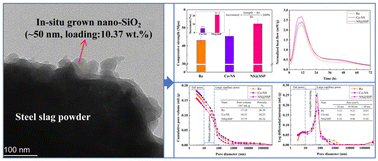
To overcome the agglomeration of nano-SiO2 (NS) in cement-based materials, NS was grown in situ on the surface of steel slag powder (SSP) via a modified Stöber method, forming a composite particle (NS@SSP) with SSP as the core and in situ grown NS (INS) as the shell. The particle size and dispersion of INS were controlled by the water-to-ethanol ratio, TEOS concentration, and reaction temperature, while the nucleation mechanism and INS loading were governed by the SSP dosage. Under the optimal synthesis conditions (a water-to-ethanol ratio of 3 : 2, a TEOS concentration of 2 : 100, a reaction temperature of 40 °C, and a SSP dosage of ≥4 : 100 g mL−1), uniformly dispersed spherical INS of ∼50 nm was achieved, yielding an INS loading of ≤10.37 wt% and no free NS agglomerates. Critically, INS was covalently anchored to the surface of SSP via Si–O–Si bonds, ensuring the stability of the core–shell structure. Consequently, compared to ultrasonically dispersed NS, INS increased the cumulative hydration heat by 10.21% within 72 h, reduced the total porosity by 13.46% at 3 days, and enhanced the 3d compressive strength by 15.2% (from 45.3 to 52.2 MPa). This work demonstrates that the in situ growth strategy is a highly effective approach for harnessing the full seeding, filling, and strengthening potential of NS in cement-based materials.
 Please wait while we load your content...


