


Substrate thermodynamics control growth and spin coupling in flexible cobalt thin films
 cd
and
Cheng-Hsun-Tony
Chang
a
cd
and
Cheng-Hsun-Tony
Chang
a
Abstract
Interfacial engineering remains a critical challenge in flexible spintronics where simultaneously optimizing crystalline quality, magnetic robustness, and proximity effects is difficult. By depositing cobalt films under constant adatom kinetic energy onto flexible substrates with contrasting enthalpies of fusion—muscovite mica (high ΔHf) and perfluoroalkoxy alkane (PFA, low ΔHf)—we demonstrate a thermodynamics-driven strategy to control growth mode, surface roughness, microstructure, and spin coupling. Atomic force microscopy and X-ray diffraction reveal layer-by-layer growth with low roughness on mica (Ra ≈ 1.7–2.3 nm) versus island-like rough morphologies on PFA (Ra up to 47.7 nm). Magnetic measurements show a 50% enhancement of coercive force and mechanical flexibility on PFA, while Pt capping layers amplify magnetic proximity effects more significantly on rougher PFA interfaces. We introduce the Thermal-Informed Roughness Activation (TIRA) model, linking substrate enthalpy and adatom energy to interfacial roughness and spintronic properties. This framework offers practical design rules for optimizing flexible spintronic devices by balancing crystallinity, magnetic coupling, and bendability.
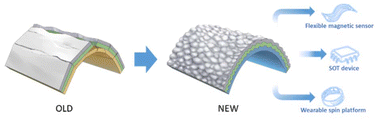
- This article is part of the themed collection: Nanoscale Covers
 Please wait while we load your content...


