


 PLATFORM UPDATE:


Bifunctional PVDF/MXene membranes with high piezoelectric sensitivity and near infrared photothermal antibacterial efficacy toward wearable human activity monitoring
 *af
*af
Abstract
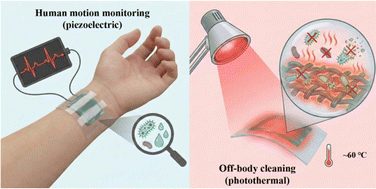
In the realm of wearable health monitoring, establishing a reliable interface that ensures both high-fidelity sensing and long-term biological safety remains a critical challenge, particularly due to the risk of bacterial infection caused by sweat accumulation at the device–skin contact. Herein, we address this issue by developing a scenario-driven, bifunctional PVDF/MXene nanofibrous membrane that integrates robust piezoelectric performance with on-demand photothermal antibacterial capability. In this design, MXene nanosheets function simultaneously as nucleating agents to boost the electroactive β-phase content of PVDF from 80.3% to 93.3% and as efficient near-infrared (NIR) photothermal agents. The optimized membrane exhibits a superior piezoelectric sensitivity of 0.502 V/N, enabling the precise detection of diverse human activities ranging from subtle pulse waveforms to vigorous jumping motions, and motion-triggered Morse code communication. Crucially, addressing the hygiene concerns of reusable wearables, the membrane achieves rapid, non-contact sterilization during off-wear intervals. Under safe NIR irradiation (0.3 W cm−2), the surface temperature rises to ∼60 °C within 60 s, achieving an antibacterial efficacy of >99% against S. aureus and E. coli. Combined with excellent in vitro cytocompatibility, this work provides a “one-structure, dual-function” solution for constructing hygienic, high-performance electronic skins.
 Please wait while we load your content...


