


 PLATFORM UPDATE:


Broadband microwave-absorbing GO–CNT nanocomposites enabled by synergistic FeCoNi ternary catalysis

Abstract
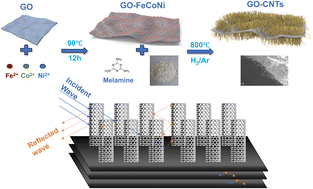
The realization of strong attenuation and broadband microwave absorption in carbon-based materials through controllable structural design remains highly challenging. In this work, a three-dimensional graphene oxide–carbon nanotube (GO–CNT) network is constructed by in situ growth of carbon nanotubes on graphene oxide substrates via chemical vapor deposition, using melamine as the carbon source and a ternary Fe–Co–Ni synergistic catalyst. Subsequent oxidation yielded a composite material featuring spinel oxide shell structures. The N-doped graphitized framework and uniformly dispersed alloy nanoparticles cooperatively form continuous conductive pathways and abundant heterogeneous interfaces, facilitating efficient dissipation of electromagnetic energy. After oxidation, the introduction of spinel-type oxide shells and additional surface defects finely regulates the balance between dielectric and magnetic responses. As a result, GO–CNTs exhibit a minimum reflection loss (RLmin) of −49.4 dB and an effective absorption bandwidth (EAB) of 4.33 GHz at a thickness of 2.2 mm, whereas the oxidized GO–CNT–O sample achieves an EAB of 5.33 GHz at a reduced thickness of 1.8 mm while maintaining an RLmin better than −35 dB. This complementary behavior demonstrates that oxidation-mediated regulation of ε–μ coupling with a single three-dimensional carbon network enables switching between deep-attenuation and broadband-absorption modes under thin-layer conditions. This study provides a practical and scalable route to tunable microwave-absorbing materials and lays a foundation for the integrated application of multidimensional carbon networks in advanced electromagnetic protection systems.
 Please wait while we load your content...


