


 PLATFORM UPDATE:


Recent advances on the hydrogen spillover effect in the design of electrocatalysts

Abstract
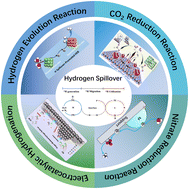
Hydrogen spillover has emerged as a pivotal mechanism enabling the directional transport of active hydrogen species (*H) in electrocatalytic systems, providing a fundamental design strategy for advanced catalyst engineering. This review systematically examines its application across four major electrocatalytic scenarios: the hydrogen evolution reaction (HER), carbon dioxide reduction reaction (CO2RR), nitrate reduction reaction (NO3RR), and electrocatalytic hydrogenation of organics. In the HER, hydrogen spillover mitigates *H accumulation on metal donors (e.g., Pt, Pd) by facilitating *H migration to the support, thereby lowering the overpotential. In the CO2RR, it promotes C–H bond formation via directed *H delivery to Cu-active sites, enhancing CH4 selectivity. For the NO3RR, precise *H supply to intermediates such as *NO2 suppresses the competing HER and reinforces NH3 generation. In organic hydrogenation, controlled *H transfer to reaction sites effectively minimizes over-hydrogenation. By optimizing the “donor-medium-reaction site” architecture, hydrogen spillover balances *H supply and consumption, offering a universal pathway to simultaneously enhance activity, selectivity, and stability in electrocatalytic systems.
- This article is part of the themed collections: Recent Review Articles and Nanoscale 2026 Emerging Investigators
 Please wait while we load your content...


