


 PLATFORM UPDATE:


Pressure-controlled oxygen activation at single metal atom sites in a manganese–cobalt coordination network on graphene: from triplet–singlet spin transition to superoxo dissociation
 b
Danilo
Comini,
b
Valentin
Mischke,
c
Nikolay
Vinogradov,
d
Mattia
Scardamaglia,
d
Mirko
Cinchetti,
c
Giovanni
Zamborlini,
ce
Paolo
Giannozzi
*af
and
Erik
Vesselli
*bgh
b
Danilo
Comini,
b
Valentin
Mischke,
c
Nikolay
Vinogradov,
d
Mattia
Scardamaglia,
d
Mirko
Cinchetti,
c
Giovanni
Zamborlini,
ce
Paolo
Giannozzi
*af
and
Erik
Vesselli
*bgh
Abstract
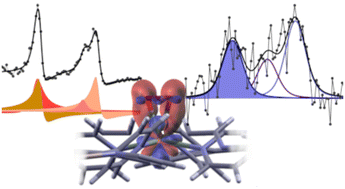
Molecular oxygen activation at single transition metal atom sites is critical for catalysis but remains challenging to control. Here we investigate a manganese–cobalt bi-metallic coordination network on graphene, where Co(I) atoms are tetracoordinated by nitrogen. Combining density functional theory with in situ infrared-visible sum-frequency generation and ambient-pressure X-ray photoelectron spectroscopy, we demonstrate pressure-dependent oxygen ligation at Co sites. Below 10−6 mbar, O2 binds reversibly in a horizontal configuration, inducing charge transfer and a triplet-to-singlet spin transition characteristic of an active superoxo O2δ− species. Increasing oxygen pressure leads to O2 dissociation, with atomic oxygen accumulating at Co(II) sites and at the support. Co-exposure to O2 and CO enables room-temperature oxidation of the latter, preventing catalyst poisoning. These findings reveal how coordination and environmental control tune spin, oxidation state, and reactivity at single metal atoms, offering pathways for rational design of atomically precise two-dimensional catalysts.
 Please wait while we load your content...


