


 PLATFORM UPDATE:

Cu-doped mesoporous TiO2 interlayer for highly efficient and stable hybrid perovskite solar cells
 *a
and
Tae Woong
Kim
*a
*a
and
Tae Woong
Kim
*a
Abstract
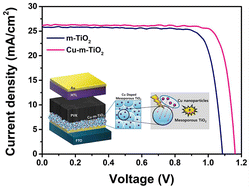
Titanium dioxide (TiO2)-based electron transport layers (ETLs) are widely used in perovskite solar cells (PSCs) but suffer from low electron mobility, deep-level defects, and detrimental interfacial recombination, which lower open-circuit voltage (VOC) and short-circuit current density (JSC) and ultimately limit power conversion efficiency (PCE). In this study, Cu-doped mesoporous TiO2 (Cu-m-TiO2) was developed, integrating the inherent structural advantages of conventional mesoporous TiO2 (m-TiO2) with interlayer engineering functionalities to overcome these limitations. In contrast to conventional m-TiO2, Cu-m-TiO2 provides optimized electronic structure, surface chemistry, and interfacial energetics through strategic Cu incorporation via photodeposition. This approach enables synergistic improvements in electron transport, defect passivation, and energy level alignment while preserving the intrinsic benefits of m-TiO2, including efficient charge extraction and interfacial carrier separation. Consequently, PSCs incorporating Cu-m-TiO2 demonstrated a VOC of 1.162 V, JSC of 26.19 mA cm−2, and fill factor (FF) of 84.4%, achieving a champion PCE of 25.68%, significantly higher than the 23.12% obtained with m-TiO2. Beyond efficiency enhancement, Cu-m-TiO2 substantially improved device longevity, retaining 94.6% of initial PCE after 2450 h under dry-room conditions without encapsulation. This multi-functional approach demonstrates transitioning from conventional single-function layers to multi-functional integrated layers for enhanced device performance.
 Please wait while we load your content...


