


 PLATFORM UPDATE:


Activity of ice-binding proteins can be markedly enhanced by protein tags
 a
Sanne N.
Giezen,
a
Tim P.
Hogervorst,
a
Renko
de Vries
b
and
Ilja K.
Voets
*a
a
Sanne N.
Giezen,
a
Tim P.
Hogervorst,
a
Renko
de Vries
b
and
Ilja K.
Voets
*a
Abstract
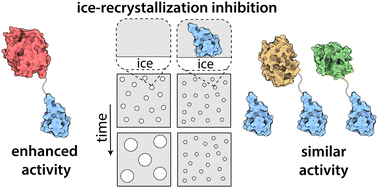
Ice-binding proteins (IBPs) are crucial for the survival of cold-adapted organisms, as they regulate ice crystal formation and growth. To understand their molecular mode of action, fluorescence microscopy of IBPs bound to ice-crystal surfaces has been shown to be very helpful, although it is unknown whether the (fluorescent) tags typically used in these studies affect the activities of the IBPs. Here, we evaluate the impact of mEos3.2, SNAP-tag, and HaloTag on the ice-recrystallization inhibition (IRI) activity of IBPs. We find that most tags, in most orientations, do not affect the IRI activity of IBPs. These tags are promising candidates for investigating the binding mechanisms of IBPs in their native form with fluorescence microscopy. A surprising exception is the N-terminal attachment of HaloTag to QAE, an isoform of AFP type III: for this case, we find an order of magnitude higher IRI activity. Additionally, we show that HaloTag also has moderate IRI activity by itself and induces the formation of ice crystals with hexagonal prism morphology, suggesting binding affinity for the primary prism plane of ice. Our findings indicate that moderately IRI-active proteins may synergistically enhance the IRI activity of IBPs, when attached in the proper orientation.
 Please wait while we load your content...


