


 PLATFORM UPDATE:


Process-dependent hypersonic phonon dispersion of brush particle metamaterials
 b
Pascal
Rembert,
b
Rebecca
Sainidou,
b
Krzysztof
Matyjaszewski,
ef
Michael R.
Bockstaller,
c
Bartłomiej
Graczykowski
g
and
George
Fytas
*agh
b
Pascal
Rembert,
b
Rebecca
Sainidou,
b
Krzysztof
Matyjaszewski,
ef
Michael R.
Bockstaller,
c
Bartłomiej
Graczykowski
g
and
George
Fytas
*agh
Abstract
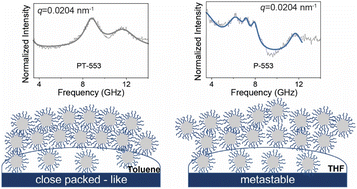
The self-assembly of polymer-grafted nanoparticles (PGN) has drawn interest as a platform approach for the fabrication of hybrid materials in which novel functionalities, such as photonic or phononic band gap formation, arise from the interplay of microstructure regularity and brush interactions. However, the complex dynamical processes associated with polymer and particle constituents render PGN assembly structures susceptible for the arrest of metastable states and impart sensitivity of physical properties to process conditions. For the case of poly(methyl methacrylate) (PMMA)-grafted silica particles, the use of volatile solvents (such as tetrahydrofuran) during film formation results in metastable microstructures with reduced effective medium sound velocity but increased width of the band gap as compared to equilibrated films cast from toluene solution. The linear acoustic dispersion obtained from Brillouin light spectroscopy combined with elastodynamic calculations suggest that the use of volatile solvents increases the free volume of PMMA, while maintaining the local order of particles within the film. Surprisingly, stop-band formation was more pronounced in metastable microstructures. The origin for this unusual behavior resides in the hybridization mechanism underlying the gap formation. Thus, the increased contrast of elastic constants ‘overcompensates’ the loss of long-range positional order and amplifies the hybridization gap that originates from the dipolar (ℓ = 1) resonance of the SiO2 cores coupled to the polymer grafts of neighboring PGNs.
 Please wait while we load your content...


