


 PLATFORM UPDATE:


Thermoelectrochemistry-enabled phase and morphology control of metal phosphide nanocrystals
 *a
*a
Abstract
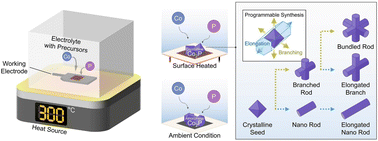
Precise control over nanocrystal morphology remains a challenge in direct electrochemical synthesis of transition metal phosphides (TMPs), typically requiring post-synthetic thermal treatment. This study exploits selective surface heating during electrochemical synthesis to overcome kinetic barriers for crystallization, enabling the preparation of highly ordered cobalt and nickel phosphide nanostructures. Systematic voltage modulation yielded Co2P nanostructures with controlled morphologies including single nanorods, branched rods, and bundled rods with tunable dimensions and facet orientation. Extension to nickel precursors produced Ni2P with octahedral and plate-like morphologies, suggesting the generalizability of this approach. Electrochemical characterization unveiled important structure–activity relationships: Co2P nanorod bundles exhibiting superior electrocatalysis (for both hydrogen and oxygen evolution reactions) compared to single nanorods, owing to the overexpressed active facets. This straightforward electrochemical synthetic platform enables rational design of catalysts through direct morphological engineering without complex post-treatment and is readily extensible to other transition metal compounds.
 Please wait while we load your content...


