


 PLATFORM UPDATE:

Non-traditional granular magnetoresistive devices: a short review

Abstract
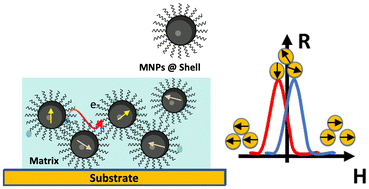
Over the past decade, thin-film-based magnetoresistive (MR) sensors have undergone significant advancements. These conventional rigid thin-film MR sensors provided high sensitivity and reliability but were limited by their mechanical rigidity and incompatibility with curved or wearable surfaces. To address this flexibility issue, later flexible MR sensors were achieved by thinning or transferring the active layers of rigid sensors onto compliant substrates, which enabled strain-tolerant operation and integration with soft electronic platforms. However, these devices still relied on conventional film-based geometries that were restricted by the high fabrication costs, complexity, and poor scalability. Non-traditional granular MR sensors have emerged as a promising direction in spintronics research owing to their cost-effective fabrication, structural simplicity, and compatibility with flexible and wearable electronics. Despite these advantages, several challenges remain, particularly the need to enhance their sensitivity for low magnetic field detection, such as biomagnetic fields. This review aims to provide a comprehensive overview of to-date reported non-traditional granular MR devices, their physical mechanisms, material configurations, fabrication strategies, and MR device performance evolution over the past two decades. We highlighted how advances in nanoparticle engineering, insulating matrices, and polymeric binders have expanded the potential of granular MR systems for next-generation flexible and printable magnetoelectronic applications.
- This article is part of the themed collections: Recent Review Articles and Nanoscale 2026 Emerging Investigators
 Please wait while we load your content...


