


 PLATFORM UPDATE:


Three-dimensionally ordered macro-/mesoporous bismuth for efficient electrocatalytic CO2 reduction to formate
 *a
*a
Abstract
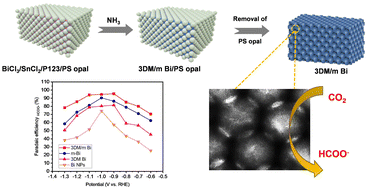
Bismuth (Bi)-based catalysts with nanoporous structures have great potential for electrocatalytic reduction of CO2 to formate. However, the direct preparation of nanoporous metallic Bi with a specific internal structure by currently used electrodeposition and in situ electroreduction methods is extremely challenging. In this study, a three-dimensionally ordered macro-/mesoporous (3DM/m) Bi catalyst was controllably fabricated by combining a low temperature wet-chemical reduction method with a hard–soft dual-template approach. In particular, ammonia gas, acting as an auxiliary reducing agent, gently facilitates the reduction of Bi3+ ions within the template, resulting in a well-defined continuous macro-/mesoporous structure. The hierarchical interconnected macro-/mesoporous architecture offers significant advantages: the mesoporous structure offers rich catalytically active sites for CO2 adsorption, while the macroporous structure accelerates the diffusion of reactants and products. As a result, the 3DM/m Bi catalyst achieves a desirable formate faradaic efficiency of 95.6% at −0.9 V vs. the reversible hydrogen electrode (RHE) and maintains over 85% formate selectivity in a wide potential range from −0.8 V to −1.2 V vs. RHE.
 Please wait while we load your content...


