


 PLATFORM UPDATE:


Staggering thermal transport in 2H-TiS2 dominated by acoustic-like optical phonons

Abstract
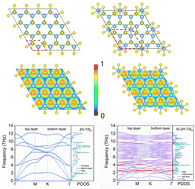
The contribution of optical phonon modes to lattice thermal conductivity is well known to be much lower than that from their acoustic counterparts. However, in this study, by combining density functional theory calculations with the solution of the Boltzmann transport equation, optical phonons in 2H-TiS2 are found to be the dominant contributors to thermal conductivity (68%), which is fundamentally different from the common picture of thermal transport. This originates from the acoustic-like optical phonons dominated by the crystal symmetry group. We further reveal that upon Ti self-intercalation, the thermal conductivity is drastically reduced from 15.84 W m−1 K−1 to 1.25 W m−1 K−1, with the contribution of optical phonons decreasing to 48%. Through a comprehensive analysis of phonon scattering mechanisms, the significant decrease in thermal conductivity with self-intercalation can be elucidated by disappearance of acoustic-like optical phonon branches, and the induced strong coupling between optical and acoustic phonons. This work opens a pathway for dynamical and reversible modulation of heat conduction in two-dimensional layered materials.
 Please wait while we load your content...


