


 PLATFORM UPDATE:

Recent progress of BiVO4-based photoanodes for photoelectrochemical water splitting
 a
and
Qizhao
Wang
*acd
a
and
Qizhao
Wang
*acd
Abstract
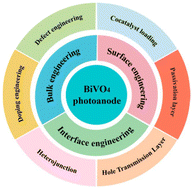
The photoelectrochemical (PEC) system, which harvests abundant solar energy and stores it in the form of hydrogen energy, offers an efficient, environmentally friendly, and renewable solution to address global energy demands and environmental concerns. Monoclinic bismuth vanadate (BiVO4) has attracted widespread attention over the past decades due to its Earth abundance, non-toxicity, suitable band structure, and visible-light absorption capability. However, its practical PEC water oxidation performance remains severely hindered by the rapid recombination of electric charge, insufficient active sites, and intrinsic kinetic limitations. In this review, we summarize the recent advances in BiVO4-based photoanodes for PEC water splitting. We first introduce the basic working mechanisms of PEC water oxidation and then delve into the primary factors restricting its efficiency. Subsequently, we summarize and analyze the latest modification strategies—including bulk engineering, surface engineering, and interface engineering—and elucidate their underlying mechanisms for improving charge separation and reaction kinetics. Finally, this paper looks ahead at the future development directions of BiVO4-based photoanodes.
- This article is part of the themed collection: Recent Review Articles
 Please wait while we load your content...


