


 PLATFORM UPDATE:


TiO2 protective capping for EUV mirrors: superior hydrogen plasma resistance and Sn contaminants removal
 *a
Jianjun
Wei
c
and
*a
Jianjun
Wei
c
and
Abstract
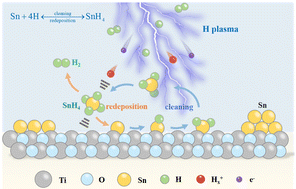
The long-term stability of extreme ultraviolet (EUV) lithography mirrors relies on protective capping layers capable of resisting plasma irradiation while simultaneously facilitating the removal of Sn contaminants. TiO2, Ru, and RuO2 coatings are comparatively assessed using density functional theory (DFT) and hydrogen-plasma cleaning experiments. TiO2 exhibits weak Sn adhesion (0.11 eV), enabling complete removal within 8 h under non-damaging power (1 W), whereas Ru/RuO2 retain persistent residues (>24 h) due to strong chemisorption and catalytic SnH4 re-deposition. TiO2 also demonstrates superior hydrogen-barrier properties, including inert adsorption (+0.34 eV), a high diffusion barrier (1.57 eV), and excellent reduction resistance. In contrast, Ru shows strong hydrogen adsorption (−0.64 eV) and low permeation barriers (1.02 eV), while RuO2 undergoes hydrogen-induced reduction with structural degradation. Comparable Sn-removal kinetics on polycrystalline and single-crystalline TiO2 further confirm insensitivity to grain boundaries. The unique combination of weak adsorption for contaminants, robust hydrogen impermeability, and reduction resistance in TiO2 establishes it as a highly effective capping layer for extending EUV mirror lifetime in plasma environments.
 Please wait while we load your content...


