


 PLATFORM UPDATE:


Nanoscale carbonaceous materials via element hyperaccumulation for electrochemical desalination application
 *a
Wei-Bin
Zhang
*a
*a
Wei-Bin
Zhang
*a
Abstract
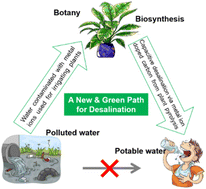
Developing renewable green electrode materials with outstanding electrochemical properties is essential for advancing the practical application of flow electrode capacitive deionization (FCDI) technology. This study introduces an innovative green biosorption approach combined with a carbonization technique to fabricate self-doped manganese biomass-derived porous carbon. The resulting composite possesses a high specific surface area of 635.24 m2 g−1, which facilitates the exposure of more active adsorption sites and ion transport pathways. Furthermore, the synergistic interaction between the electric double-layer capacitance of biomass-derived porous carbon and the pseudocapacitance of transition metal manganese enables the electrode material to show exceptional electrochemical performance, achieving a specific capacitance of 137.30 F g−1 at a current density of 0.25 A g−1. When integrated into an FCDI system, the electrode material reaches a high salt adsorption capacity of 459.51 mg g−1 and a high average desalination rate of 9.95 mg g−1 h−1 under identified optimal conditions. Moreover, after extended desalination cycles, the retention rates for both salt adsorption capacity and average desalination rate remain approximately 70%. Notably, this novel approach not only paves the way for designing transition metal-doped biomass-derived porous carbon materials but also contributes to mitigating environmental pollution caused by manganese metals.
- This article is part of the themed collection: 2026 Chinese New Year and Lunar New Year Collection
 Please wait while we load your content...


