


 PLATFORM UPDATE:


Surface functionalization of graphene-based materials: enhancing the performance and sustainability of cement composites

Abstract
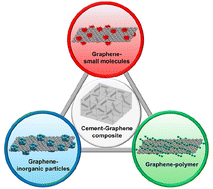
Graphene-based materials exhibit outstanding mechanical strength, exceptionally high specific surface area, and remarkable electrical and thermal conductivity, positioning them as transformative reinforcements for next-generation cementitious composites. Despite their potential, several critical challenges impede their practical implementation, including poor dispersibility in the highly alkaline cement pore solution, pronounced aggregation tendencies, limited compatibility with cement hydration products, and suboptimal load transfer within the composite matrix. To overcome these limitations, surface functionalization of graphene-based materials has emerged as a robust and versatile strategy. Functionalization with small molecules, inorganic nanoparticles, or polymeric systems enables precise tailoring of surface chemistry, significantly enhancing dispersion stability and interfacial reactivity. Small-molecule functionalization facilitates targeted modification of reactive sites on graphene nanosheets, enhancing its compatibility with cement hydrates and fostering stronger interfacial interactions. Inorganic nanoparticles, including oxides of iron, indium, and silica, serve as nucleation sites for hydration products, strengthening the interfacial transition zone and enhancing composite durability. Polymeric functionalization, achieved through covalent grafting or non-covalent adsorption, not only stabilizes dispersions but also enables fine-tuning of the mechanical, electrical, and thermal properties of the hardened composite. Over the past decade, significant progress in these functionalization strategies has led to accelerated hydration kinetics, refined microstructural development, and superior mechanical performance. This Minireview critically assesses recent progress in the functionalization of graphene-based materials for cement composites, emphasizing the synergistic effects of these approaches. Finally, it discusses persistent challenges and outlines future opportunities for developing multifunctional high-performance graphene-based cementitious materials tailored for large-scale construction applications.
- This article is part of the themed collections: Recent Review Articles and Nanoscale 2026 Emerging Investigators
 Please wait while we load your content...


