A surfactant-mediated Ni/MgAl bifunctional catalyst for highly selective tandem conversion of acetone to methyl isobutyl ketone

Abstract

Highly efficient conversion of acetone to methyl isobutyl ketone (MIBK) remains a challenging task due to the complicated reaction pathways. Herein, a surfactant-assisted impregnation strategy was developed to modify Ni/MgAl catalysts for acetone conversion. Interestingly, the introduction of surfactants can effectively modulate the catalyst acidity and basicity, thereby blocking the reaction pathway, leading to the isophorone by-product. Moreover, a sodium dodecyl sulfate (SDS) modified catalyst (Ni/MgAl-SDS) exhibited a Ni2+-doped solid solution structure, as well as the conventional impregnated Ni/MgAl catalyst, while a sodium dodecylbenzene sulfonate (SDBS) modified catalyst (Ni/MgAl-SDBS) generated highly dispersed metallic nanoparticles with coexisting Ni0/Ni2+ species. This unique structure efficiently drove the hydrogenation of a mesityl oxide intermediate, achieving a high MIBK selectivity of 94.5% in the acetone conversion process. This strategy provides a novel approach for the synergistic regulation of the metal state, acidity and basicity in tandem reactions.
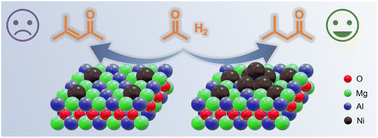
Graphical abstract: A surfactant-mediated Ni/MgAl bifunctional catalyst for highly selective tandem conversion of acetone to methyl isobutyl ketone

Supplementary files

Article information

Article type
Paper
Submitted
22 Oct 2025
Accepted
21 Jan 2026
First published
27 Jan 2026
This article is Open Access
Creative Commons BY-NC license

Nanoscale, 2026, Advance Article

A surfactant-mediated Ni/MgAl bifunctional catalyst for highly selective tandem conversion of acetone to methyl isobutyl ketone

Z. Zhang, S. Huang, J. Sun, Q. Yuan, Y. Zhu and X. Liu, Nanoscale, 2026, Advance Article , DOI: 10.1039/D5NR04445F

This article is licensed under a Creative Commons Attribution-NonCommercial 3.0 Unported Licence. You can use material from this article in other publications, without requesting further permission from the RSC, provided that the correct acknowledgement is given and it is not used for commercial purposes.

To request permission to reproduce material from this article in a commercial publication, please go to the Copyright Clearance Center request page.

If you are an author contributing to an RSC publication, you do not need to request permission provided correct acknowledgement is given.

If you are the author of this article, you do not need to request permission to reproduce figures and diagrams provided correct acknowledgement is given. If you want to reproduce the whole article in a third-party commercial publication (excluding your thesis/dissertation for which permission is not required) please go to the Copyright Clearance Center request page.

Read more about how to correctly acknowledge RSC content.

Social activity

Spotlight

Advertisements