


 PLATFORM UPDATE:


Dual modulation of BiOCl: enhancing photocatalytic antibiotic degradation through Co surface bonding and a WS2 heterojunction
 a
and
Hanbing
Zhang
*a
a
and
Hanbing
Zhang
*a
Abstract
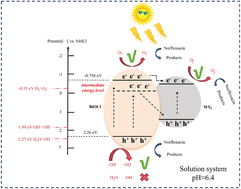
The persistence of fluoroquinolone antibiotics like norfloxacin in aquatic environments necessitates advanced treatment solutions. Photocatalysis emerges as an effective strategy, wherein BiOCl has garnered significant attention due to its unique layered structure and favorable band characteristics. However, the performance of BiOCl is limited by narrow visible-light absorption and rapid charge recombination. Traditional modification methods involving prolonged high-temperature/pressure treatments risk damaging its intrinsic structure. This study innovatively presents a mild sonochemical strategy that establishes Co surface bonding and constructs a BiOCl/WS2 heterojunction, realizing the introduction of hybrid energy levels and the regulation of heterostructure formation simultaneously. The Co–BiOCl/WS2 composite demonstrated the successful formation of Co–Cl bonds and WS2 heterojunction integration, with a 0.35 eV bandgap reduction alongside significantly enhanced visible-light absorption and charge separation efficiency. The Co–BiOCl/WS2 composite achieved 92.37% norfloxacin degradation within 60 min under visible light with a reaction rate constant 1.95 times higher than that of BiOCl, while maintaining excellent stability across various environmental conditions. The degradation pathways were elucidated by combining Fukui function calculations predicting the piperazine ring's vulnerability with HPLC-MS analysis. This work provides a facile strategy for dual-functional modification of BiOCl under mild conditions and offers valuable insights for designing efficient photocatalysts for antibiotic wastewater treatment.
 Please wait while we load your content...


