


Medium matters: modeling the luminescence spectra and emission decay of LaPO4:Eu3+ nanoparticles

Abstract
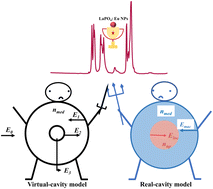
The arguments for the use of the appropriate model to describe the behavior of nanoparticles (NPs) in different environments have extended over many decades with conflicting experimental evidence and interpretation. LaPO4:Eu3+ NPs have been dispersed in organic solvents, pressed into glass discs, melted in glass discs, and prepared as phosphor in glass (PiG) ceramics and then melted at higher temperature. Besides the emission spectra, the parameters (i) emission decay lifetimes and (ii) relative intensity of bands allowed by electric dipole (ED) and magnetic dipole (MD) mechanisms (i.e., ED : MD intensity ratios) have been studied and fitted according to model output parameters as a function of refractive index of the materials. The parameters for LaPO4:Eu3+ NPs dispersed in alcohols are accounted for by refractive index changes. In compressed discs, the NPs are located on surfaces and spectral properties do not change noticeably with glass composition. In the PiG materials, the change in glass surroundings of the moiety with glass composition can create a large change in polarizability and hence ED : MD intensity. Therefore, in this case the ED : MD and R2 ratios are not only determined by refractive index but also by chemical affinity: i.e., the ionic – covalent nature of neighbors. In melted glasses or melted PiG at higher temperature, the LaPO4:Eu3+ moiety is destroyed and Eu3+ is incorporated into the glass framework. The experiments demonstrate the versatility in spectral properties and opportunities for tuning these when nanoparticles are dispersed in different media.
 Please wait while we load your content...


