


 PLATFORM UPDATE:


Mechanically encoded strain-vector keys as physical unclonable functions
 *b
and
*b
and
Abstract
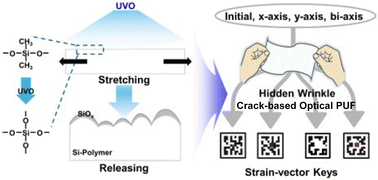
Advances in hacking and counterfeiting demand new security architectures. Optical physically unclonable functions (PUFs), which derive their cryptographic strength from optical responses to structural randomness, are promising platforms for next-generation security. However, despite considerable effort, achieving high readout reliability under various light conditions, stability, and reconfigurability in optical PUFs for practical use remains challenging. Here we present an optical PUF based on disordered wrinkles arising from a Young's modulus mismatch between a silicone–polymer surface and its bulk. These mechanically encoded wrinkles produce unclonable optical responses under varied illumination, and treating the applied strain vector as the challenge markedly expands the key space. In addition, rotating the region of interest provides a simple route to reconfiguration. The resulting PUF exhibits near-ideal performance across an expanded and reconfigured challenge–response space. Patterns generated by the PUF reliably serve as identifiers and cryptographic keys for mutual authentication and image encryption. This mechanically encoded PUF is poised to provide a robust platform for next-generation security systems.
- This article is part of the themed collection: Nanoscale 2026 Emerging Investigators
 Please wait while we load your content...


