


 PLATFORM UPDATE:


Laser-induced graphene: from precursor chemistry to process control and throughput–resolution–performance trade-offs
 *abc
*abc
Abstract
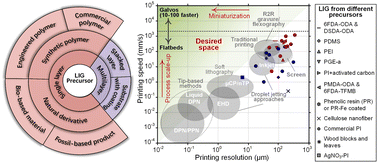
Laser-induced graphene (LIG) has matured from a laboratory curiosity into a versatile platform for fabricating porous, conductive carbon architectures directly on flexible polymers and bio-derived substrates. While prior reviews have catalogued devices and applications, a unifying framework connecting the precursor molecular structure, laser process parameters, resulting LIG morphology, and measured properties has been missing. This review fills that gap by advancing a process–structure–property perspective that explicitly links precursor chemical conversion, laser energy delivery, and post-processing to graphitization pathways, scalability, and device-level performance. We first organize the carbon precursors by function into single-layered (synthetic and natural/fossil derivatives) and multilayered (stacked and coated). We then distill how the molecular architecture, inherent heteroatoms, and composite design steer bond scission, outgassing, and sp2-bond formation. We then map laser fluence and kinetics to morphology transitions (from isotropic porous to anisotropic cellular and woolly fibers) and show how these regimes co-evolve with defect density and sp2 fraction, thereby governing sheet resistance, capacitance, wettability, and catalytic activity. Building on this, we review different process control approaches, including laser-assisted transfer, 3D-printing inspired assembly, and multi-pass laser scribing for in situ engineering of the resulting LIG, including for property enhancement, doping and nanophase formation. These methods highlight how engineered sequential or hybrid irradiation decouples feature definition from graphitization and enables chemistry and morphology control at scale. A quantitative scalability map is introduced to reveal trade-offs among printing speed, resolution, and sheet resistance, identifying an underexplored window where sub-20 μm features coexist with <100 Ω sq−1 conductivity. To ground sustainability claims, we propose a multi-stage energy and emissions framework (from precursor production to laser process control and post-processing) that enables like-for-like comparisons across polyimides, lignin-rich papers, and fossil-based feedstock. Finally, we end with an outlook articulating three key research priorities: (i) systematic precursor libraries that relate monomer chemistry and heteroatom speciation to graphitization kinetics; (ii) in situ diagnostics (time-resolved Raman/GC-MS/thermography) to capture transient intermediates; and (iii) manufacturing strategies that combine multiple wavelengths to access uncovered performance windows. By centering chemistry–morphology control within a manufacturing and process-control context, this review offers actionable design rules to translate LIG from benchtop demonstrations to robust, high-throughput devices.
- This article is part of the themed collections: Recent Review Articles and Nanoscale Covers
 Please wait while we load your content...


