


 PLATFORM UPDATE:


The supramolecular architecture of amyloid fibrils formed by a human tau-derived hexapeptide VQIVYK

Abstract
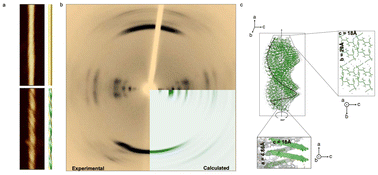
The sequence 306VQIVYK311 is an aggregation-prone region of the tau protein implicated in driving the assembly of tau into paired helical filaments. These filaments accumulate as intraneuronal neurofibrillary tangles in Alzheimer's disease and a range of tauopathies. Prolonged incubation of VQIVYK results in highly ordered fibrillar structures that give rise to unusually detailed and highly oriented X-ray fibre diffraction patterns. These mature fibrils provided the opportunity to use a novel integrative approach that combined X-ray fibre diffraction analysis with 3D contact point reconstruction atomic force microscopy (CPR-AFM) of individual filaments to determine molecular and supramolecular details. X-ray diffraction analysis resulted in a molecular model consistent with an X-ray crystallography structure, which could be further optimised to give rise to a highly twisted filamentous protofilament architecture. Analysis of individual fibril envelopes by CPR-AFM revealed a diverse polymorphous population with a major fibril morphology of apparently smooth, cylindrical fibrils, and morphological subpopulations of fibrils with clear left-handed twisting patterns, while X-ray diffraction suggests that the protofilament core structure remains consistent between the polymorphs. Here, we reveal that VQIVYK amyloid fibrils form a polymorphous amyloid population by assembly of highly ordered protofilaments. The combined approach provides novel molecular and supramolecular information regarding the structure of highly twisted amyloid fibrils.
 Please wait while we load your content...


