


 PLATFORM UPDATE:

Albumin coating of magnetic nanoparticles for imaging, tracking and delivery through biological barriers
 ah
Riccardo
Di Corato,
d
Clara
Piccirillo,
a
Giuseppe
Maruccio,
ah
Amilcare
Barca
g
and
Alessandra
Quarta
*a
ah
Riccardo
Di Corato,
d
Clara
Piccirillo,
a
Giuseppe
Maruccio,
ah
Amilcare
Barca
g
and
Alessandra
Quarta
*a
Abstract
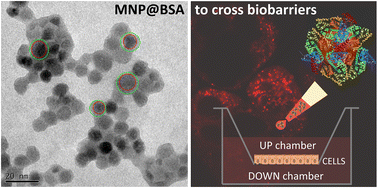
The advent of nanotechnology in biotechnology and medicine has accelerated the development of nanomaterials as innovative tools for diagnostics, therapy, and drug delivery. Despite their versatility, many nanoparticle systems fail in vivo due to their limited ability to traverse biological barriers, resulting in off-target distribution, rapid clearance, or undesired bioaccumulation. Structural parameters—including size and surface chemistry—critically shape nanoparticle biodistribution and fate. Albumin, the most abundant serum protein, naturally acts as a long-circulating carrier capable of transporting diverse molecules across biological interfaces. Owing to its stability and favorable pharmacokinetics, albumin has emerged as a valuable component of drug delivery systems and nanoformulations. In this work, we introduce albumin-coated magnetic zinc ferrite nanoparticles as a platform designed to overcome these limitations. Our results show that an albumin coating markedly enhances nanoparticle stability and provides a versatile shell that can encapsulate lipophilic drugs or incorporate tracking agents. Functionally, the albumin-coated nanoparticles demonstrate efficient penetration and transport across biological barriers in vitro: they successfully enter 3D breast tumor spheroids and show measurable translocation across an enterocyte monolayer model. These findings highlight the potential of albumin-coated magnetic zinc ferrite nanoparticles as multifunctional carriers for targeted delivery and biomedical imaging, and support the relevance of 3D models for assessing nanoparticle transport and therapeutic efficacy.
- This article is part of the themed collection: Magnetic Nanoparticles: From Massart Method to a Cascade of Innovations
 Please wait while we load your content...


