Nanoscale Control over Single Vortex Motion in an Unconventional Superconductor

Abstract

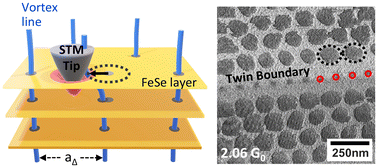
Precise control of superconducting vortices is crucial for studying vortex dynamics and vortex braiding. We propose a new method to pull vortex lines in the multigap superconductor FeSe using a scanning tunneling microscope (STM) tip. Point defects and strain-induced wrinkles act as trapping potentials, deforming vortex lines and altering local vortex lattice configurations. Weak contact of the STM tip with the FeSe surface selectively suppresses the larger superconducting gap while leaving the smaller gap intact, thereby creating a tunable vortex pinning potential. This enables controlled vortex line deformation even in dense vortex lattices. Analytical modeling reveals that the deformation strength scales logarithmically with conductance and depends on tip geometry. Our findings point to local strain–induced gap suppression as the mechanism for STM-mediated vortex manipulation, providing a fundamental insight relevant to vortex behavior in the context of quantum information studies.
Supplementary files

Transparent peer review

To support increased transparency, we offer authors the option to publish the peer review history alongside their article.

View this article’s peer review history

Article information

Article type
Paper
Submitted
08 Oct 2025
Accepted
22 Feb 2026
First published
23 Feb 2026
This article is Open Access
Creative Commons BY-NC license

Nanoscale, 2026, Accepted Manuscript

Nanoscale Control over Single Vortex Motion in an Unconventional Superconductor

S. Y. Song, C. Hua, G. Halasz, W. Ko, J. Yan, B. J. Lawrie and P. Maksymovych, Nanoscale, 2026, Accepted Manuscript , DOI: 10.1039/D5NR04204F

This article is licensed under a Creative Commons Attribution-NonCommercial 3.0 Unported Licence. You can use material from this article in other publications, without requesting further permission from the RSC, provided that the correct acknowledgement is given and it is not used for commercial purposes.

To request permission to reproduce material from this article in a commercial publication, please go to the Copyright Clearance Center request page.

If you are an author contributing to an RSC publication, you do not need to request permission provided correct acknowledgement is given.

If you are the author of this article, you do not need to request permission to reproduce figures and diagrams provided correct acknowledgement is given. If you want to reproduce the whole article in a third-party commercial publication (excluding your thesis/dissertation for which permission is not required) please go to the Copyright Clearance Center request page.

Read more about how to correctly acknowledge RSC content.

Social activity

Spotlight

Advertisements