


Negatively charged Janus membranes with robust pore anti-wettability for stable membrane distillation of seawater
 *abc
*abc
Abstract
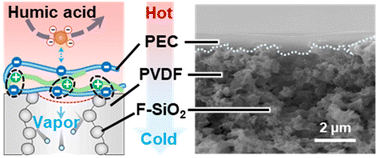
Janus membranes with hydrophilic surfaces have been developed to mitigate natural organic fouling during membrane distillation (MD) seawater desalination. Nevertheless, most Janus membranes remain susceptible to fouling and pore wetting during prolonged operation, primarily attributed to the penetration of negatively charged humic acid (HA) through hydrophilic layers and the lack of bulk hydrophobicity across the membrane. Herein, we develop a Janus membrane, featuring a negatively charged hydrophilic polyelectrolyte complex (PEC) layer and pore surfaces with tailored hydrophobicity, for stable MD seawater desalination. The PEC layers with negatively charged surfaces are fabricated via a rapid droplet superspreading strategy with aqueous phase separation. The robust hydrophobicity is achieved by constructing nanostructures on the pore surfaces using hydrophobic silica (F-SiO2) nanoparticles. The resulting PEC-based Janus membranes exhibit stable MD flux (29.0 kg m−2 h−1) and high salt rejection rates (>99.9%) during the cyclic desalination of the simulated seawater. Our strategy demonstrates promising potential for developing high-performance MD membranes for seawater desalination.
 Please wait while we load your content...


