


 PLATFORM UPDATE:


Ag/Pd bimetallic sites embedded in g-C3N4 nanosheets synergistically catalyze Suzuki coupling and nitroaromatic reduction reactions

Abstract
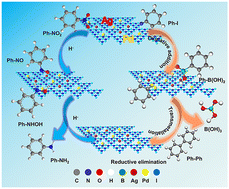
Transition metal (Pd) mediated C–C coupling reactions are key synthetic approaches among organic reactions and have become an integral part of synthetic endeavors. This study employs high-temperature pyrolysis to embed AgPd dual active sites within graphitic carbon nitride (g-C3N4), enabling highly efficient carbon–carbon coupling reactions and reduction of nitroaromatics. The prepared AgPd-C3N4 showed excellent catalytic performance in Suzuki–Miyaura coupling and transfer hydrogenation reactions of nitroaromatics. The reaction rate and selectivity of AgPd-C3N4 were superior to those of Pd-C3N4 and Pd-C3N4 under mild conditions. Both characterization results and density-functional theory calculations indicate that the abundant Ag inside AgPd-C3N4 can provide electrons to Pd in the adjacent sites, which significantly increases the reaction rate of the oxidative addition step during the Suzuki–Miyaura coupling reaction. The π–π conjugation effect between aryl halides and g-C3N4 also helps to accelerate the reaction. Under the same conditions, the yield of the Suzuki–Miyaura coupling reaction catalyzed by AgPd-C3N4 (98%) exceeded that of Pd-C3N4 (79%). Furthermore, the synergistic interaction between the bimetallic centers improved the catalytic activity of AgPd-C3N4 in nitroaromatic transfer hydrogenation reactions. The formation of Ag–Nx and Pd–Nx coordination bonds improved the dispersion and stability of Ag and Pd nanoparticles. This study provides a new strategy for the rational design of high-performance bimetallic catalysts based on carbon nitride.
 Please wait while we load your content...


