


 PLATFORM UPDATE:


Charge transport and trap state engineering in transition metal-doped bismuth vanadate photoanodes: a DFT study
 *ab
*ab
Abstract
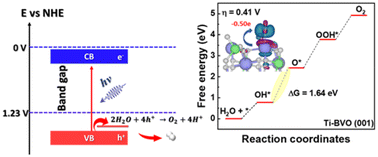
Bismuth vanadate (BiVO4, BVO) is a widely studied photoanode material for photoelectrochemical (PEC) water splitting due to its suitable band gap, which enables efficient visible light absorption. However, its practical performance is significantly limited by poor charge carrier separation and low mobility, resulting in high recombination rates and reduced photocatalytic efficiency. To overcome these challenges, we propose a novel doping strategy involving the substitution of V5+ sites with cations of varying oxidation states, specifically 4+, 5+, and 6+ to modulate the structural, electronic, and catalytic properties of BVO. Using density functional theory (DFT) calculations, we systematically investigate the impact of these dopants on the crystal structure, electronic band structure, charge transport behavior, and oxygen evolution reaction (OER) energetics. Among the doped systems, Ti4+-doped BVO (Ti-BVO) demonstrates superior OER performance, primarily due to a reduced hole effective mass and an improved charge carrier mobility of 0.3802 cm2 V−1 s−1 for holes and 0.1527 cm2 V−1 s−1 for electrons. Additionally, the increased diffusion lengths for holes (99.2 nm) and electrons (62.89 nm) contribute to more efficient charge separation and transport. The calculated overpotential for Ti-BVO is significantly reduced to 0.41 V, compared to 0.97 V for pristine BVO, indicating a substantial improvement in reaction kinetics. These findings provide valuable insights for designing BVO-based next-generation photoanode materials.
 Please wait while we load your content...


