Carbon fibers with infiltrated TiO2 nanocrystalline layers: photocatalytic performance

Abstract

This study examines the synergy of carbon fibers (CFs) and an infiltrated TiO2 nanocrystalline layer for photocatalytic degradation of methylene blue (MB). The CFs@TiO2 nanocomposite was developed using Vapour Phase Infiltration (VPI) of TiO2 into polyacrylonitrile fibers with 5–160 infiltration cycles and subsequently carbonized at 900 °C. This integrated production method enables precise integration of TiO2 and consistent coating over the fiber surface. SEM confirms the TiO2 layer thickening from 15.7 ± 2.4 nm to 34.7 ± 3.4 nm as the cycles increase from 40 to 160, while EDX and EDXRF indicate a similar rise in TiO2 content. XRD and Raman spectroscopy confirm the production of anatase TiO2 for VPI 40 c and higher, attributed to size-induced crystallization. UV–Vis DRS demonstrates that the optical bandgap varies with the cycle number in accordance with the development of the TiO2 layer. The outcomes of photocatalytic experiments under UV illumination indicate that the maximum degradation rate is achieved with the thickest coating. The CFs@TiO2 demonstrate exceptional cycle stability. This study emphasizes the potential of VPI-derived CFs@TiO2 as durable and effective photocatalysts.
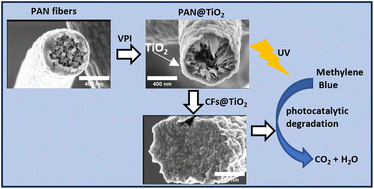
Graphical abstract: Carbon fibers with infiltrated TiO2 nanocrystalline layers: photocatalytic performance

Supplementary files

Article information

Article type
Paper
Submitted
28 Sep 2025
Accepted
30 Nov 2025
First published
01 Dec 2025
This article is Open Access
Creative Commons BY-NC license

Nanoscale, 2026, Advance Article

Carbon fibers with infiltrated TiO2 nanocrystalline layers: photocatalytic performance

P. K. Chennam, M. Rihova, S. Azpeitia, M. Sepúlveda, M. Kachlík, M. Pouzar, V. Čičmancová, K. Maca, M. Knez and J. M. Macak, Nanoscale, 2026, Advance Article , DOI: 10.1039/D5NR04109K

This article is licensed under a Creative Commons Attribution-NonCommercial 3.0 Unported Licence. You can use material from this article in other publications, without requesting further permission from the RSC, provided that the correct acknowledgement is given and it is not used for commercial purposes.

To request permission to reproduce material from this article in a commercial publication, please go to the Copyright Clearance Center request page.

If you are an author contributing to an RSC publication, you do not need to request permission provided correct acknowledgement is given.

If you are the author of this article, you do not need to request permission to reproduce figures and diagrams provided correct acknowledgement is given. If you want to reproduce the whole article in a third-party commercial publication (excluding your thesis/dissertation for which permission is not required) please go to the Copyright Clearance Center request page.

Read more about how to correctly acknowledge RSC content.

Social activity

Spotlight

Advertisements