


 PLATFORM UPDATE:


Predicting the optical and thermoelectric properties of the SnC–HfBrCl van der Waals heterostructure

Abstract
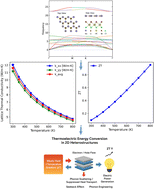
Motivated by the promising thermoelectric characteristics of two-dimensional (2D) SnC and Janus HfBrCl monolayers, this study employs first-principles calculations to systematically investigate the electronic, mechanical, dynamic, thermal, optical, and thermoelectric properties of their vertically stacked van der Waals heterostructure (vdWH). Structural stability is confirmed through elastic constant analysis, phonon dispersion calculations, and ab initio molecular dynamics (AIMD) simulations, demonstrating robust mechanical, dynamic, and thermal integrity. Electronic band structure calculations reveal indirect band gaps of 0.83 and 1.59 eV (PBE and HSE06, respectively) without spin–orbit coupling (SOC), which are reduced to 0.76 and 1.54 eV, respectively, upon inclusion of SOC. Crucially, the heterostructure forms a staggered type-II band alignment, which spatially separates electrons and holes, making it highly favorable for optoelectronic applications. This is corroborated by the pronounced visible-range optical absorption obtained from Bethe–Salpeter equation (BSE) calculations that include electron–hole interactions. The interfacial structural asymmetry enhances phonon scattering, leading to reduced lattice thermal conductivities of 12.02, 11.16, and 11.59 W m−1 K−1 at 300 K along the x- and y-directions, as well as the average value, respectively. Combined with favorable carrier transport, the optimized thermoelectric performance yields a figure of merit of ZT = 0.96 at 800 K, with performance improving at elevated temperatures. These results establish the SnC–HfBrCl vdWH as a multifunctional platform that simultaneously combines competitive high-temperature thermoelectric efficiency, strong visible-light absorption, and robust thermal stability.
 Please wait while we load your content...


