


 PLATFORM UPDATE:


A hierarchical BCN–MoS2 nanocomposite for the electrochemical hydrogen evolution reaction in natural seawater: comparative studies across various electrolytes

Abstract
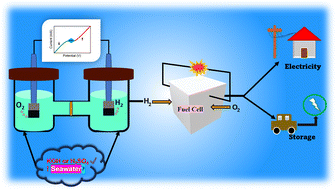
Layered transition metal dichalcogenides (TMDs) have emerged as pivotal 2D materials for electrocatalytic hydrogen evolution, yet their performance is often constrained by limited conductivity and active site availability. In this work, a hierarchical BCN–MoS2 nanocomposite, comprising defect-rich Boron Carbon Nitride (BCN) nanosheets interleaved with MoS2 nanoflakes, is developed to synergistically enhance hydrogen evolution reaction (HER) activity. The defects within BCN facilitate electron transfer, while their interaction with MoS2's edge sulfur sites and van der Waals interfaces promotes catalytic synergy. The composite demonstrates remarkable HER performance with overpotentials of 87 mV and 252 mV in acidic and alkaline media, respectively, at 10 mA cm−2, alongside favourable Tafel slopes of 80 and 103 mV dec−1, indicating accelerated reaction kinetics. To address real-world applicability, the catalyst was evaluated in natural seawater, yielding an overpotential of 579 mV and 43-hour long stability, with performance degradation attributed to ionic precipitation. Notably, supplementing seawater with KOH significantly improved activity, achieving a reduced overpotential of 60 mV at 10 mA cm−2. These findings highlight the composite's potential for sustainable hydrogen generation under diverse aqueous conditions.
 Please wait while we load your content...


