


 PLATFORM UPDATE:


Using molecular amphiphiles to dope nano-Au with Cu2+: 20-fold higher magnetic dopant density and evidence for a proximity Kondo effect
 *ab
*ab
Abstract
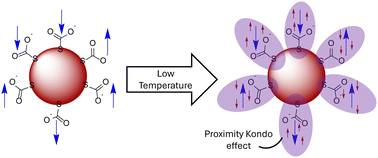
Kondo scattering was originally observed in Au alloys containing dilute magnetic dopants. While higher densities reveal additional exotic quantum phenomena in other materials, advances combining Au and molecular systems have only increased magnetic dopant density to 0.1%. We demonstrate for the first time a doping method employing ions (Cu2+ or Zn2+), bifunctional, amphiphilic molecular wires (4-mercaptobenzoic acid) and nano-Au systems (nano-aggregates or thin films). (1) The high surface-to-volume ratios of nanostructures and (2) the abilities for bifunctional molecules to form closely-packed, self-assembled monolayers and bind ions yield >20-fold higher densities than previously reported. We observe hallmark signatures of the Kondo effect at low temperature: the nano-aggregates magnetic moment decreases ∼50–70% and film resistance increases logarithmically. Significantly, here the dopants are outside the Au, providing evidence for a “proximity” Kondo effect for the first time. These results demonstrate that quantum nanostructured materials enable a promising, bottom-up approach for exploring strongly correlated quantum phenomena.
 Please wait while we load your content...


