


 PLATFORM UPDATE:


Intercalation of bismuth nanoparticles into Ti3C2 MXene as an anode material for lithium-ion batteries
Yizhou
Zhang  *a
*a
*a
Abstract
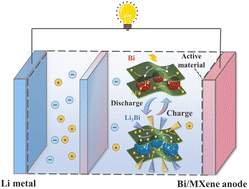
Bismuth (Bi) metal is considered an ideal anode material for lithium-ion batteries (LIBs). However, its poor structural stability during cycling, caused by expansion and cracking, remains a significant challenge. Here, we design a Bi/MXene composite via a one-step reduction process, to address these issues. Bi nanoparticles are uniformly incorporated into Ti3C2 MXene layers, enhancing structural stability and preventing agglomeration. The Bi/MXene nanosheet delivers an exceptional specific capacity, exceeding 300 mAh g−1 over 500 cycles at 1.0 A g−1. Its electrochemical performance is controlled by both ion-diffusion and pseudocapacitive mechanisms, ensuring outstanding cycling performance.
 Please wait while we load your content...


