


 PLATFORM UPDATE:


Engineered S-scheme g-C3N4/MnO2 heterostructures for integrated photo-rechargeable supercapacitors with enhanced energy storage performance

Abstract
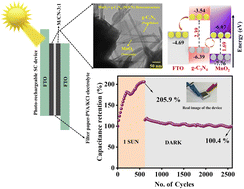
Engineering a two-in-one multifunctional device that couples energy conversion and storage offers a smarter strategy to address the current global energy crisis while reducing reliance on grid electricity. Photo-rechargeable supercapacitors are perfect devices for the storage of light-induced electrochemical energy, garnering increasing attention as the next-generation energy storage technology. This study presents a novel 2D/1D g-C3N4/MnO2-based photocathode architecture, reported for the first time, for the fabrication of a solid-state photo-rechargeable supercapacitor device. Here, g-C3N4 functions as the light-capturing component, while MnO2 acts as the primary charge-storing element for the device. Photoluminescence (PL) results confirm that the MnO2/g-C3N4 S-scheme architecture promotes efficient photoexcited charge separation and suppresses their recombination. Upon light illumination, the optimized device exhibits a ∼23% enhancement in areal capacitance, compared to its performance in the dark at 0.7 mA cm−2. Under light exposure, the fabricated device retains double its areal capacitance after 600 cycles and achieves 100% retention after 2000 cycles under dark conditions, highlighting its outstanding cycling stability. This remarkable performance is ascribed to the presence of oxygen vacancy-mediated trap states in MnO2, which reduce charge carrier recombination during light illumination and facilitate charge transfer kinetics. The proposed S-scheme charge transfer mechanism is further validated by the combined evidence from Scanning Kelvin Probe (SKP) and Mott–Schottky measurements. These findings emphasize the promise of the g-C3N4/MnO2 S-scheme heterojunction for efficient light-assisted energy storage, making a significant advancement for an emerging class of materials. As the proof-of-concept, the device powered a red LED for 33 s in the dark and for up to 43 s under light illumination.
 Please wait while we load your content...


