Ultrafast dynamics of relaxation in well-dispersed quantum-confined nanographenes

Abstract

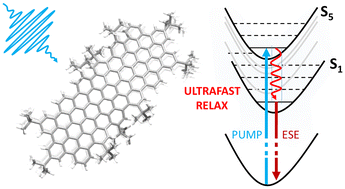
Recently developed graphene quantum dots (G-QDs), presenting exceptional dispersion stability, a precisely controlled number of conjugated carbon rings and a photoluminescence quantum yield of almost unity, allow scrutinization of their intrinsic photophysics and potential quantum-confined effects related to their excited-state dynamics. Here we use transient absorption with 30–40 fs resolution to probe electronic relaxation in rectangular G-QDs composed of exactly 96, 114 and 132 carbon atoms. Through the growth of excited-state emission signals over the ground-state bleaching ones, the dynamics of relaxation are unveiled. The relaxation time ranges between 130 and 180 fs, which leads to a maximum global energy-loss rate of 5 eV ps−1. Energy-selective excitation measurements show that this ultrafast relaxation rate is limited by vibrational relaxation rather than the internal conversion process. This reveals the proximity between the excited-state energy surfaces and the key role of high-frequency vibrational modes in driving these ultrafast relaxation dynamics.

Graphical abstract: Ultrafast dynamics of relaxation in well-dispersed quantum-confined nanographenes

Supplementary files

Transparent peer review

To support increased transparency, we offer authors the option to publish the peer review history alongside their article.

View this article’s peer review history

Article information

Article type
Paper
Submitted
15 Sep 2025
Accepted
09 Dec 2025
First published
10 Dec 2025

Nanoscale, 2026, Advance Article

Ultrafast dynamics of relaxation in well-dispersed quantum-confined nanographenes

S. Quistrebert, D. Medina-Lopez, C. Banga-Kpako, T. T. Huynh, S. Campidelli, J. Lauret and E. Cassette, Nanoscale, 2026, Advance Article , DOI: 10.1039/D5NR03896K

To request permission to reproduce material from this article, please go to the Copyright Clearance Center request page.

If you are an author contributing to an RSC publication, you do not need to request permission provided correct acknowledgement is given.

If you are the author of this article, you do not need to request permission to reproduce figures and diagrams provided correct acknowledgement is given. If you want to reproduce the whole article in a third-party publication (excluding your thesis/dissertation for which permission is not required) please go to the Copyright Clearance Center request page.

Read more about how to correctly acknowledge RSC content.

Social activity

Spotlight

Advertisements