


 PLATFORM UPDATE:


Unravelling the amplified spontaneous emission mechanism in three-dimensional metal halide perovskites

Abstract
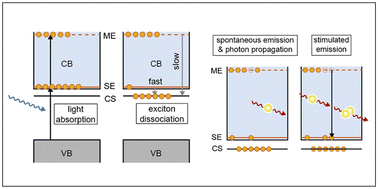
Metal halide perovskites have demonstrated outstanding optical gain properties, attracting extensive research for their potential in laser applications. To further improve their lasing performance, a detailed understanding of underlying light amplification is essential. Herein, we investigate how film thickness influences amplified spontaneous emission (ASE) properties in the methylammonium lead iodide (MAPbI3) perovskite. By carefully maintaining consistent material composition and crystallinity, we isolate the effect of film thickness on ASE behavior. Femtosecond pump–probe spectroscopy reveals that thinner films facilitate the formation of multiexciton (ME) states, which are strongly correlated with ASE transitions. However, thin films suffer from weaker optical confinement, limiting photon feedback. In contrast, thicker films exhibit enhanced optical confinement but reduced ME population. The influences of thickness-dependent exciton-state dynamics and optical confinement explain the non-monotonic variation in the ASE threshold, which reaches its lowest value near 150 nm, where exciton generation and optical confinement are optimally balanced to maximize light amplification. These findings offer practical design guidelines for the development of high-performance perovskite laser devices.
 Please wait while we load your content...


