


 PLATFORM UPDATE:


Interfacial atomic orbital controlled spin-hybridization proximity effects in vdW heterostructures
 *a
*a
Abstract
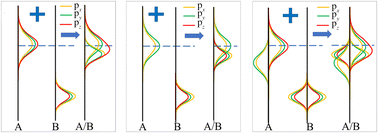
Interfacial effects have emerged as a promising tool in engineering localized and global magnetic properties of van der Waals heterostructures. Understanding the underlying mechanism of such interfacial effects is crucial for precise control over the interface induced properties and phenomena. Herein, this paper proposes a hypothesis on the deterministic role of atomic sub-orbitals of interfacial atoms in interfacial spin hybridization, which controls the magnetic proximity effect between a magnetic conductor and a non-magnetic material with a band gap. This work demonstrates that the mere presence of electronic bands of adjacent materials in the same energy window in a heterostructure does not ensure interfacial hybridization. Instead, atomic sub-orbitals of interfacial atoms – particularly the pz orbital – are the principal hybridizing agents. We propose that the asymmetric contribution of pz-up and pz-down orbitals to the Fermi level of magnetic conductors is the principal parameter that governs induced magnetism via hybridization proximity in non-magnets.
 Please wait while we load your content...


