


 PLATFORM UPDATE:


Enhancing colloidal stability of anisotropic magnetic nanodiscs through mesoporous silica and P(NIPAM/MAA) copolymer coatings
 ab
Micaela A.
Macchione,
ac
Santiago
Marzini Irranca,
ef
Eduart
Gutiérrez Pineda,
a
Sunisa
Thongsom,
a
Danijela
Gregurec
*d
and
Sergio E.
Moya
*ag
ab
Micaela A.
Macchione,
ac
Santiago
Marzini Irranca,
ef
Eduart
Gutiérrez Pineda,
a
Sunisa
Thongsom,
a
Danijela
Gregurec
*d
and
Sergio E.
Moya
*ag
Abstract
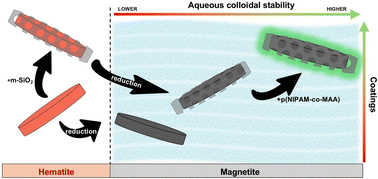
Magnetic nanodiscs (MNDs), a class of anisotropic magnetite nanomaterials, have attracted considerable attention in smart actuation as they can generate heat through hysteretic losses and their discoidal shape can be tuned to exhibit vortex magnetization and generate mechanical stimuli. Despite near-zero net magnetization, at high concentrations, interparticle forces become dominant leading to MND aggregation. Here, we have optimized a previously reported synthetic approach based on the synthesis of hematite templates subsequently converted into a magnetite phase. We show that removal of oleic acid (OA) during the reduction step results in the same colloidal stability as in the presence of OA but avoids erosion of the MNDs associated with OA. We introduce a thin mesoporous silica coating on the surface of hematite, effectively diminishing aggregation during reduction while allowing complete conversion into magnetite. This silica layer facilitates subsequent silane chemistry and the grafting of poly(N-isopropylacrylamide-co-methacrylic acid) P(NIPAM/MMA) coatings with 80 : 20 and 50 : 50 ratios, yielding highly stable aqueous suspensions of MNDs, both in aqueous and cell culture media. These findings establish a versatile pathway toward colloidally stable MNDs, thereby broadening their applicability in biomedical research.
- This article is part of the themed collection: Magnetic Nanoparticles: From Massart Method to a Cascade of Innovations
 Please wait while we load your content...


