


 PLATFORM UPDATE:


Gas transformations within metal–organic cages
 ab
and
Edmundo G.
Percástegui
*ab
ab
and
Edmundo G.
Percástegui
*ab
Abstract
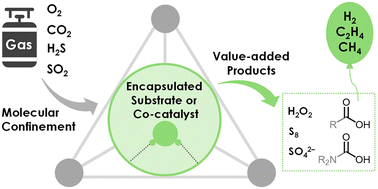
The efficient transformation of gaseous molecules into value-added products remains a central challenge in sustainable chemistry, limited by the low reactivity of some gases and the complexity of achieving product selectivity. Metal–organic cages (MOCs), with their tunable cavities and dynamic host–guest interactions, have emerged as promising platforms for gas conversion, leveraging confinement effects to enhance reactivity and selectivity. This contribution highlights recent advances in MOC-mediated gas transformations—including photocatalytic O2 reduction, electrochemical CO2 conversion to combustible gases, H2S splitting for H2 generation, and SO2 oxidation and mineralization—illustrating how spatial arrangement, co-encapsulation of catalysts and substrates, and cavity design unlock new reaction pathways under mild conditions. Mechanistic insights and structural features outline design principles for next-generation cage-based systems. Ultimately, MOCs offer molecular precision to bridge homogeneous and heterogeneous catalysis, with profound implications for the development of complex gas–liquid–solid phase reactions and transformative technologies aimed at addressing some of the most critical challenges in environmental remediation, energy generation, and circular manufacturing.
- This article is part of the themed collections: Recent Review Articles and Reactivity and Self-Assembly in Confined Spaces
 Please wait while we load your content...


