


 PLATFORM UPDATE:


Size-dependent two-photon absorption and ultralow optical-limiting response in atomically-thin rhodonite
 cde
Alexander A.
Safronov,
e
Dipak Kumar
Goswami,
a
Chandra Sekhar
Tiwary
*g
and
Prasanta Kumar
Datta
*a
cde
Alexander A.
Safronov,
e
Dipak Kumar
Goswami,
a
Chandra Sekhar
Tiwary
*g
and
Prasanta Kumar
Datta
*a
Abstract
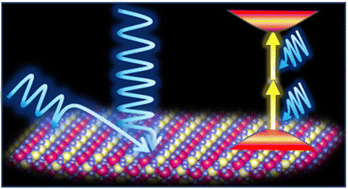
Atomically-thin materials continue to captivate researchers due to their extraordinary physical properties that often surpass those of their bulk forms. Among them, two-dimensional (2D) silicates hold particular promise, yet their nonlinear optical characteristics remain largely underexplored. This study provides an in-depth analysis of the size-dependent nonlinear optical response and optical limiting characteristics of 2D rhodonite nanoflakes, a non-layered silicate mineral, under femtosecond laser excitation. A pronounced enhancement in two-photon absorption is observed as the material transitions from large flakes (∼40 nm thickness) to few-layer structures (∼2.5 nm thickness), with the two-photon absorption coefficient increasing from the 103 to 104 cm GW−1 range, highlighting the influence of dimensional tuning. Few-layer rhodonite exhibits an ultralow optical limiting threshold of 0.38 mJ cm−2, outperforming many benchmark 2D materials, including graphene, TMDCs and MXenes. Density functional theory analysis indicates that the enhanced two-photon absorption in 2D rhodonite arises from the contributions of Fe orbitals originating from electronic states near the Fermi level. In addition, the increased probability of two-photon absorption can also be attributed to transitions between orbitals of similar character with strong contributions, which occur as a result of the hybridization between Si and O p orbitals. These findings position 2D rhodonite as a highly promising candidate for next-generation photonic technologies, including optical switching, 3D microfabrication, and quantum information processing.
 Please wait while we load your content...


