


 PLATFORM UPDATE:


Synergistic regulation of the Zn2+ solvation environment and interfacial stability using a rhodamine 6G additive in aqueous zinc ion batteries
 *a
Guozhao
Fang
b
*a
Guozhao
Fang
b
Abstract
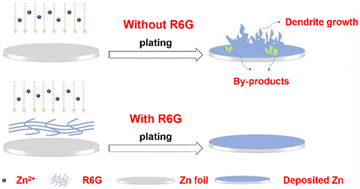
In response to the challenges faced by zinc anodes in aqueous zinc-ion batteries, such as dendrite growth and interface corrosion, this study introduces rhodamine 6G (R6G) as an electrolyte additive. The collective evidence from DFT calculations and experimental characterization studies—specifically, the binding energy (−15.11 eV), the adsorption energy (−2.533 eV), and the HOMO–LUMO gap (1.102 eV)—reveals a dual-function mechanism: (1) polar groups (–NHCH2CH3 and –COOCH2CH3) preferentially replace the coordinated water molecules in the first solvation layer of Zn2+, reducing the desolvation energy barrier and (2) the rigid conjugated skeleton adsorbs on the zinc surface via π–Zn interactions, contributing to the formation of a protective organic–inorganic composite SEI film. As observed from the electrochemical testing results, the optimized R6G electrolyte enables Zn||Zn cells to undergo 1410 h of cycling at 0.5 mA cm−2/0.5 mAh cm−2 and 219 h at 5 mA cm−2/5 mAh cm−2. Meanwhile, the Zn||Cu cell achieves an average coulombic efficiency of 99.7% after 1200 cycles. The Zn||MnO2 full cell exhibited a specific capacity of 152 mAh g−1 after 1200 cycles at 1 A g−1 with a capacity retention rate of 76.4%. Therefore, the “coordination substitution-interface film formation” synergistic model proposed in this study provides novel insights for the design of highly stable zinc anodes.
 Please wait while we load your content...


