Atomic ribbon formation in the pulsed laser patterning of WS2 layers

Abstract

The precise modulation of the thickness of two-dimensional (2D) semiconductor transition metal disulfides (TMDs) by laser thinning techniques to tailor their electronic properties is recognized as a promising approach. However, achieving sub-diffractive patterning during layer-by-layer modulation is crucial for junction fabrication and device engineering. Herein, we report atomic nanoribbon generation in single-layer tungsten disulfide (WS2), namely, the atomic laser-induced periodic surface structure (atomic-LIPSS) effect, achieved by tuning the laser pulse width, energy and other processing parameters. We explore the structural evolution of WS2 during laser processing for monolayer and multilayer films and compare it with another more commonly encountered 2D material, MoS2. It is verified experimentally and by molecular dynamics simulations (MD) that such atomic nanoribbons can only be formed under the action of short-pulse (<ns) lasers.
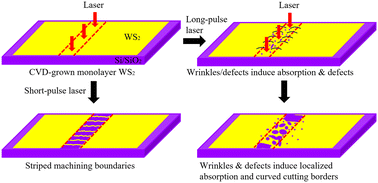
Graphical abstract: Atomic ribbon formation in the pulsed laser patterning of WS2 layers

Supplementary files

Transparent peer review

To support increased transparency, we offer authors the option to publish the peer review history alongside their article.

View this article’s peer review history

Article information

Article type
Paper
Submitted
31 Aug 2025
Accepted
18 Feb 2026
First published
19 Feb 2026
This article is Open Access
Creative Commons BY-NC license

Nanoscale, 2026, Advance Article

Atomic ribbon formation in the pulsed laser patterning of WS2 layers

Y. Hu, Z. Wang, Z. Zhang and J. Guan, Nanoscale, 2026, Advance Article , DOI: 10.1039/D5NR03677A

This article is licensed under a Creative Commons Attribution-NonCommercial 3.0 Unported Licence. You can use material from this article in other publications, without requesting further permission from the RSC, provided that the correct acknowledgement is given and it is not used for commercial purposes.

To request permission to reproduce material from this article in a commercial publication, please go to the Copyright Clearance Center request page.

If you are an author contributing to an RSC publication, you do not need to request permission provided correct acknowledgement is given.

If you are the author of this article, you do not need to request permission to reproduce figures and diagrams provided correct acknowledgement is given. If you want to reproduce the whole article in a third-party commercial publication (excluding your thesis/dissertation for which permission is not required) please go to the Copyright Clearance Center request page.

Read more about how to correctly acknowledge RSC content.

Social activity

Spotlight

Advertisements