


Enhancing the chlorine evolution performance of Ru-based DSA electrodes via cobalt incorporation for the direct electrolysis of seawater
 *ef
Yifei
Sun,
*g
*ef
Yifei
Sun,
*g
Abstract
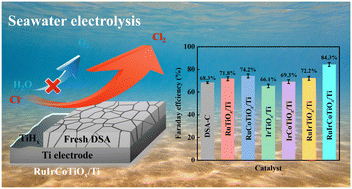
Titanium-based metal oxide anodes have strong application potential in chlorine evolution antifouling systems for seawater electrolysis. Conventional dimensionally stable anodes (DSA) rely primarily on Ru- and Ir-based noble metal coatings, yet their large-scale industrial application is hindered by high costs and poor chlorine production efficiency. To overcome the aforementioned shortcomings, Co is introduced into the RuIrTiOx/Ti system, adopting a preparation process involving oxalic acid pretreatment and a multi-step coating to fabricate RuIrCoTiOx/Ti electrodes. XRD and TEM results indicated the formation of a solid solution coating with uniformly dispersed elements on the electrode. The RuIrCoTiOx/Ti electrode demonstrated superior catalytic activity and offered nearly 84.3% faradaic efficiency for chlorine evolution compared with its binary or ternary metal oxide-coated counterparts. Remarkably, the electrode maintained over 98.1% of its initial activity after 200 hours of continuous electrolysis. However, the slightly reduced durability of RuIrCoTiOx/Ti compared to that of RuIrTiOx/Ti may be caused by the increased specific surface area of the mixed oxide coating and formation of higher valence states of Ru species after Co incorporation, as evidenced by SEM and XPS results. This study provides an effective design strategy for developing low-cost, high-efficiency DSA electrodes, offering promising prospects for industrial applications.
 Please wait while we load your content...


