


Solvent-driven self-assembly and polarized emission in nitrogen-doped graphene quantum dots
 a
Abu Bakar
Siddique,
a
Maritza Iveth
Pérez Valverde,
a
Madhusoodanan
Reghunathan,
b
Domingo Ixcoatl
García Gutiérrez,
bc
Mallar
Ray
*a
a
Abu Bakar
Siddique,
a
Maritza Iveth
Pérez Valverde,
a
Madhusoodanan
Reghunathan,
b
Domingo Ixcoatl
García Gutiérrez,
bc
Mallar
Ray
*a
Abstract
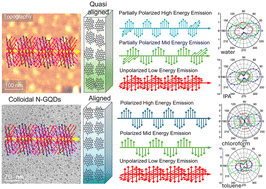
Nitrogen-doped graphene quantum dots (N-GQDs) are tunable nanoscale fluorophores whose photoluminescence (PL) is governed by core states, edge defects, and surface chemistry. Beyond these intrinsic factors, the surrounding medium can fundamentally alter their optical response, yet the influence of solvent-induced self-assembly on polarized emission has remained largely overlooked. Here, we provide the first direct spectroscopic evidence that solvents not only modulate emission intensity but also drive quasi-alignment of emitting dipoles in N-GQDs, producing liquid-crystal-like ordering within colloidal dispersions. Polarization-resolved PL reveals that the three principal emissive pathways of N-GQDs respond differently to solvent environments: non-polar solvents with high positive zeta potential promote tighter dipole alignment and stronger polarization anisotropy, whereas polar solvents broaden orientation distributions and stabilize excited states. These findings establish solvent-induced self-assembly as a critical mechanism for tailoring polarized emission in N-GQDs, opening new directions for solvent-responsive nanomaterials in adaptive light sources, reconfigurable optoelectronics, and next-generation energy-harvesting platforms.
 Please wait while we load your content...


